

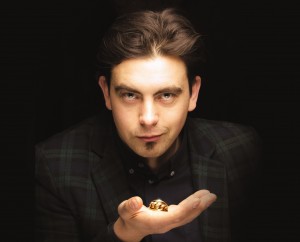
Oskars PETRAUSKIS – saxophone
Conductor Guntis KUZMA
Programme:
Claude DEBUSSY – “Prelude to the Afternoon of a Faun”
Anders Koppel Concerto No. 2 for saxophone and orchestra
Rihards ZAĻUPE – Symphony “Namejs”
The great event of the concert – the premiere of a new Latvian symphony.
Rihards Zaļupe has written a large-scale work whose kernel was originally born as a theme for a feature film; later, when it turned out that there would be no film, it grew into a sweeping symphonic score. Behind the idea lies the first book of Laimonis Purs’s (1922) Zemgale tetralogy, “The Burning Hill Fort” (1962), which tells of the battles of the Semigallians against the crusaders, led by Nameisis, or Namejs.
Alongside Rihards Zaļupe’s new work – Claude Debussy’s beautifully hazy tone painting “Prelude to the Afternoon of a Faun”, often held to be the true starting point of 20th-century music, and a dazzling sonic adventure by the contemporary Danish composer Anders Koppel: his Second Concerto for saxophone and orchestra, with Latvia’s most brilliant classical saxophonist Oskars Petrauskis as soloist.
At the LNSO’s conductor’s desk for this concert is Guntis Kuzma, assistant to the orchestra’s artistic director and chief conductor Andris Poga – a superb clarinettist who has spent recent years studying symphonic conducting at the Jāzeps Vītols Latvian Academy of Music, taking his bachelor’s degree in 2014 under Mārtiņš Ozoliņš.
Rihards Zaļupesays of his new work “Namejs”: “As the basis for the symphony I used Laimonis Purs’s novel “The Burning Hill Fort”, which takes us to 13th-century Zemgale. It is a hugely important period in the history of the Latvian people. The German crusaders, supplied with fighting strength by the whole of the Europe of the day with the Pope’s support and blessing, invaded the Baltic lands with fire and sword and pressed eastwards – seeking to seize the Russian lands and their markets. In the great battle fought on the ice of Lake Peipus in 1242, the Russian forces under Alexander Nevsky defeated the crusaders and halted their expansion to the east. In Latvia and Estonia, however, the crusaders took firm hold. The Livonians, Latgalians, Selonians and Curonians lost their freedom; resistance to the invaders held out longest in Zemgale.”
Claude Debussy’s “Prelude to the Afternoon of a Faun”was composed in 1892–94, inspired by a poem by Stéphane Mallarmé. The premiere was a resounding success. Following the composer’s own instruction, there is nothing descriptive here, only a dream: the faun, having given up chasing nymphs and naiads in the hot midday sun, gives himself over to the fulfilment of his dream and to merging with nature and the universe. Some music historians hold that this piece marks the symbolic beginning of the modern era in music.
Anders Koppel, son of the grand old man of Danish composition Herman D. Koppel and brother of the composer Thomas Koppel, learned to play the piano, the clarinet and the organ. He drew inspiration from the scores of Prokofiev and Jolivet. Essential to Koppel’s style is the presence of jazz and rock as well as Latin American and Balkan music. Koppel takes Beethoven as the yardstick for the quality of his daily work. He is an adherent of tonal music. In 1967 Anders Koppel became a co-founder of the rock bandSavage Rosewhich toured Europe and the USA. In the 1970s he worked a great deal in the studio as a musician and producer. Since the 1980s he has turned more towards composition. Koppel has composed eight ballets for theNew Danish Dance Theatrecompany, music for 150 films, 50 theatre productions and three musicals. His list of works also includes instrumental chamber music and 20 concertos, which he himself rates most highly.