

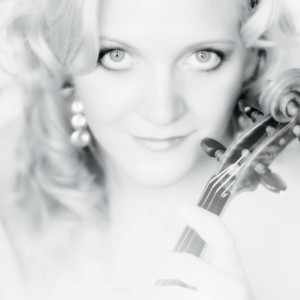
Vineta SAREIKA – soloist (violin) and director
Conductor Andris POGA
Programme:
Vilnis ŠMĪDBERGS – “Sea Patterns” (Premiere)
Jean SIBELIUS – Concerto for violin and orchestra in D minor, Op. 47
Sergei RACHMANINOFF – “Symphonic Dances”
The LNSO’s season finale celebration, with the ever-welcome violinist Vineta Sareika as soloist in the Violin Concerto of this year’s great anniversary composer, Jean Sibelius. Also on the programme are Sergei Rachmaninoff’s “Symphonic Dances”, written far from Russia with all the emotional weight of a mature life and a longing for the bells of the churches of home, as well as a premiere – the watercolours of the sea drawn by Vilnis Šmīdbergs, born and raised in Ventspils, in his new work “Sea Patterns”.
For its 2014–2015 season finale concert the LNSO invitedVilnis Šmīdbergsto compose a new work lasting about a quarter of an hour. One of the LNSO’s suggestions was to consider the sea in symphonic language. Vilnis Šmīdbergs was born and grew up in Ventspils, and in an interview with the magazine “Mūzikas Saule” he says: “The sea is still dear to me. When I come to Rīga I feel short of air – I cannot draw a proper lungful, as they say. The moment I reach Ventspils I feel it at once: that rich Ventspils sea air. A completely different person!”
After long reflection the composer settled on the title“Sea Patterns”. One is the visible layer – the swell of the sea, an even weave when we look into the distance, and a shimmering criss-cross texture when we look at the waves close up or from a cliff top, the best vantage point of all for watching the play of light and the crossing of its rays. The other is an abstract field of associations – water as a carrier of information, the sea as part of the single system of the world’s salt water, a keeper of cosmic knowledge.
Vilnis Šmīdbergs says: “I approach the sea with great reverence. My new work will certainly not be a sonic illustration of the sea. What interests me is the interplay of different layers, the projection of the patterns of the waves onto a polyphonic score, ceaseless gradations of dynamics, the micro-phrasing of textural elements – the task is very difficult and also very interesting. In a way it will be musical graphics. Seen from another side – an act of worship before the phenomenon of the sea.”
The programme also holds two classics of Romanticism – the Violin Concerto by Jean Sibelius, the great anniversary composer of 2015, and Sergei Rachmaninoff’s “Symphonic Dances”.
Rachmaninoff’s “Symphonic Dances”are the crowning achievement of the composer’s output – one of the very last works of the master. They were written when Rachmaninoff had already been living in exile for twenty years and still could not forget Russia, the source of his muse. In exile he composed rarely and little, earning his living from his phenomenal gifts as a pianist. Even so, he could now and then be persuaded to create a masterpiece, and the “Symphonic Dances” are without doubt one of the most beautiful, and most dramatic, examples of the genre ever written. Rachmaninoff himself said: “This is my last flare-up.” Andris Poga’s special affinity with Rachmaninoff’s genius makes this concert one to await with keen interest.
Sibelius’s Violin Concerto in D minor, Op. 47is an unquestioned classic of the genre, even though, ever since its unsuccessful premiere in 1904, attitudes to it have ranged widely from admiration to outright rejection (the eminent French musicologist Antoine Goléa, for instance, called this music “an absolute musical void”). It has also attracted its share of affectionate wit – recall the giant of British music history Donald Tovey, who described the concerto’s finale as “a polonaise for polar bears”. Be that as it may, Sibelius’s Violin Concerto is played all over the world, and the LNSO is genuinely delighted to invite Vineta Sareika to make music together in the Finnish master’s anniversary year.
Artemis Quartetfirst violinVineta Sareikagained a superb grounding with Ojārs Kalniņš at the Jūrmala Music School, and went on to study in Paris with Gérard Poulet and in Brussels with Augustin Dumay. She is a laureate of the 2009 Queen Elisabeth International Violin Competition, and this success in one of the most demanding competitions in the world launched her international career. Her career on stage has taken in solo appearances with outstanding orchestras and conductors, chamber music, and duties as leader of symphony orchestras. In 2011 Vineta Sareika became principal concertmaster of the Royal Flemish Philharmonic. For several years she played in the chamber ensemble she had co-foundedTrio Dali, which enjoyed success in competitions and was praised to the skies by the critics. In 2012 Vineta was offered the first violin chair in one of the world’s most brilliant string quartets, and a new chapter opened in her life as a musician, playing in an ensemble of the very highest rank. Vineta Sareika plays a violin made by Giuseppe Guadagnini in 1793, entrusted to her on loan by a private sponsor.