

Conductor Andris VECUMNIEKS
Programme:
Pyotr Tchaikovsky, Alexander Glazunov, Antonio Vivaldi, and new works by the young composers Līva Blūma, Oļesja Kozlovska and Leonīds Lobrevs
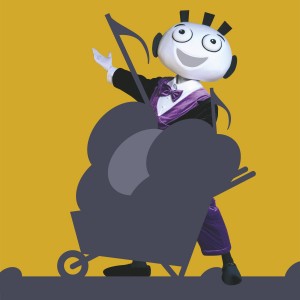
This season LeNeSOns is turning to work in the garden, but by now he is so used to music that he cannot stick a spade into the ground without the inspiring chords of a symphony orchestra. At the autumn concert LeNeSOns’s musical allies will be the audience favourite Vivaldi, this year’s great anniversary composer Tchaikovsky, and three young composers – Līva Blūma with her fierce rake, Oļesja Kozlovska with her honey-loving bear and Leonīds Lobrevs with a hymn to all that is green.
Lending a hand with LeNeSOns’s gardening will be the familiar team behind the LNSO children’s mornings – the playwright Lauris Gundars, the director Paula Pļavniece, the video artist Austra Hauks and the conductor Andris Vecumnieks. Whether Agent GWF (Garden Work Fanatic) will turn up as well is impossible to say, but then one cannot simply take the doings of a spy and post them on the internet for all to see.
Antonio Vivaldi’s music will dazzle LeNeSOns’s helpers with Italian virtuoso passagework, letting us watch both peasants at the harvest festival and hunters going about their business in the nearby wood. The violin solo will be played by Alise Bondarenko, a pupil of Olga Isakova at the Emīls Dārziņš Music School.
We shall also be led to the ripening wheat and the hunting grounds at the forest’s edge by Pyotr Tchaikovsky’s “The Seasons”, only drawn here in the musical language of the Romantic age. After that – having looked in briefly at Sergei Rachmaninoff’s “Fair” – we shall be ready to give ourselves over to unmusical pleasures during the interval, so that in the second half of the concert we can judge what kind of symphonic music is written by those who are still learning to write symphonic music.
Oļesja Kozlovska has met two bears – a bassoon and a tuba – and at first these bears are rather aggressive, but when they fail to get at the honey by force, both grow calm and watch with interest as professional beekeepers go about their work. In the end everyone gets some very tasty honey.
Leonīds Lobrevs begins his piece with a green light which, as he puts it himself, symbolises the beginning of new life. Then come sprouting, growing and flowering. For Leonīds the green element is the fifth basic element of all our lives, and we shall hear an affirming tribute to this miracle of green light.
And last of all Līva Blūma and the story of the Fierce Rake, whose splintery nature the wise Caretaker gently mends, quite simply by exchanging the bad handle for a good one. The cheerfully whistleable musical motif Līva has chosen shows the Caretaker and the Rake, swinging their legs playfully, riding home in a lorry after a job of autumn leaf-gathering well done.
Playwright Lauris Gundars
Artist Austra Hauks
Director Paula Pļavniece