

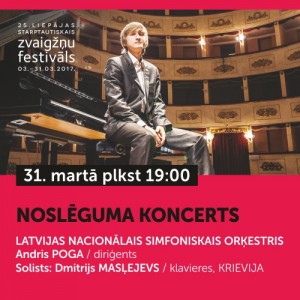
Dmitry MASLEEV – piano
Conductor Andris POGA
Programme:
Wolfgang Amadeus MOZART – Piano Concerto No. 24 in C minor, K 491
Dmitri SHOSTAKOVICH – Symphony No. 12 (“1917”)
The LNSO under Andris Poga has the honour of closing the 25th Liepāja International Stars Festival.
One programme – Mozart and Shostakovich. The first: the very embodiment of eighteenth-century musical classicism, the balancer of light and dark, Apollo and faun in one ordinary human body and, in the boundlessness of the spirit, blessed by a divine touch. The second: the embodiment in art of the tragedy of twentieth-century Russia and of the whole world, a hapless mouse in the cat’s claws of totalitarianism, and a great composer.
Wolfgang Amadeus Mozart composed the Piano Concerto No. 24 at the same time as the opera “The Marriage of Figaro”, and a greater contrast between two works is hard to imagine – as major-key and lively as the opera is, so minor-key and restless is the concerto, yet undeniably a work of genius; and the very turn to C minor, which the great Salzburger felt so deeply in his wedding mass, is the foundation on which a piece of unrepeatable mastery and impact is built.
In Mozart’s Piano Concerto No. 24 we will hear the solo playing of Dmitry Masleev, first-prize winner of the most recent Tchaikovsky Competition. Anyone who followed that competition will know that the victory did not come easily to Dmitry. Even after the competition, jury members expressed diametrically opposed views about the top four prizewinners, yet the young Siberian’s playing was undeniably deep, vivid, technically flawless, spiritually calm and monolithic in conception. This will be Dmitry Masleev’s first visit to Latvia.
Dmitri Shostakovich’s Symphony No. 12 is a marginal work in music history – rarely played even in Russia, let alone elsewhere in the world, so we have a rare chance to form our own opinion of a symphony dedicated to Lenin and composed at a time when the composer was literally forced to join the Communist Party, after which more than one of Shostakovich’s colleagues came close to turning away from him.
The symphony’s four movements depict the events of 1917: the first portrays Petrograd across the two revolutions of a single year; the second, “Razliv”, is dedicated to Lenin, who hid from the Provisional Government by that lake; in the third Shostakovich shows us, quite illustratively, the firepower of the cruiser Aurora’s guns; and finally, in the fourth, “The Dawn of Humanity” is depicted, it seems, not without irony and even sarcasm, in caricatural likeness to the pompous finale of Shostakovich’s own Fifth Symphony.
Given when the symphony was written – the early 1960s – and the context of the historical events it depicts, listening to this work with modern ears is an intellectual adventure. One may wonder why the West turned so sharply against this music, may guess why the symphony is so rarely heard today, may weigh it against Shostakovich’s other works, and may in the end recall Mstislav Rostropovich’s remark that Shostakovich’s conscience simply would not let him write works openly dedicated to the history and reality of the Soviet state in a way that would leave them in the history of music.
Knowing that one of the LNSO’s strengths is Russian music and Shostakovich in particular, we can expect a vivid experience, with Andris Poga – a master of philosophical calm and symphonic sweep – as our guide.
A historical note: the LNSO under Leonīds Vīgners played Shostakovich’s Symphony No. 12 on 29 October 1961 – barely a month after the premiere, which took place on 1 October simultaneously in Kuybyshev (conductor Abram Stasevich) and Leningrad (conductor Yevgeny Mravinsky). In Moscow the Twelfth was first conducted by Konstantin Ivanov on 15 October, and that may be seen as an upbeat to the 22nd Congress of the CPSU, which some historians consider a more significant sign of the brief thaw than the legendary 20th Congress with its only partial unmasking of Stalin.