
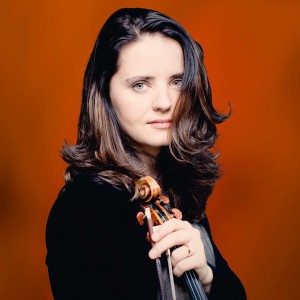
The LNSO is delighted to be making music again with the outstanding violinist Baiba Skride, and for the occasion a rarely heard work has been chosen – the Polish composer Karol Szymanowski‘s (1882–1937) Second Violin Concerto (1933). Karol Szymanowski’s music unfortunately reaches Latvian listeners far too seldom, and both of his violin concertos are undoubtedly classics of the genre that deserve to appear on concert bills far more often.
The Second Violin Concerto brims with romantic enchantment and glowing orchestral colour; the violin has room to show both a soulful boundlessness in its cantilena, or song, and a powerful temperament in the expansive cadenza, or solo passage, which was shaped with the help of the work’s dedicatee – the eminent Polish violinist Paul (Paweł) Kochański.
Baiba Skride’s gifts are especially well suited to unlocking Szymanowski’s masterpiece, as a wonderful recording confirms – at the end of 2014 the label Orfeo released a CD on which Baiba Skride, with the Oslo Philharmonic Orchestra and Vasily Petrenko, recorded both Szymanowski violin concertos. The disc was named BBC Music Magazine‘s recording of the month, BBC Music Choice, and German music critics included it in the quarterly list of distinctions, Bestenliste.
The last time the LNSO, Andris Poga and Baiba Skride worked together was at the first “LNSO vasarnīca” festival in August 2015, performing Benjamin Britten’s Violin Concerto.
The second half of the concert brings Pyotr Tchaikovsky‘s (1840–1893) Sixth Symphony (1893), known as the “Pathétique”. This symphony is Tchaikovsky’s last completed work; it was first performed a week and a half before the composer’s death. Curiously, at that first hearing the new symphony met with a rather reserved reception, and only after Tchaikovsky’s death did it win the fame it enjoys today.
Tchaikovsky had a definite programme in mind for the symphony, but he disclosed it to no one, so all we have are the guesses of relatives and friends that the work may be autobiographical. This is in fact one of those rare cases in which every theme in a symphony is a hit, melodies known even to people far removed from classical music. The symphony’s dramatic effect owes much to the abrupt contrast between the third movement, bursting with vitality, and the fourth and final movement, sinking into profound grief. The title “Pathétique” was suggested by Tchaikovsky’s brother Modest.
The concert opens withIgor Stravinsky‘s (1882–1971) youthful “Scherzo fantastique” (1908). It is often associated with bees, since the composer is said to have drawn inspiration from Maurice Maeterlinck’s natural-history essay “The Life of the Bee”. In his memoirs, however, Stravinsky denies Maeterlinck’s influence, though he admits that bees as a phenomenon always intrigued him – and that he keeps himself healthy by eating a small dish of honey every day. The “Scherzo fantastique” was in fact written simply as a brilliant example of symphonic music; the bees were added without the composer’s knowledge by the choreographer Léo Staats, who used the score for a ballet production in 1917.
Baiba Skride – violin